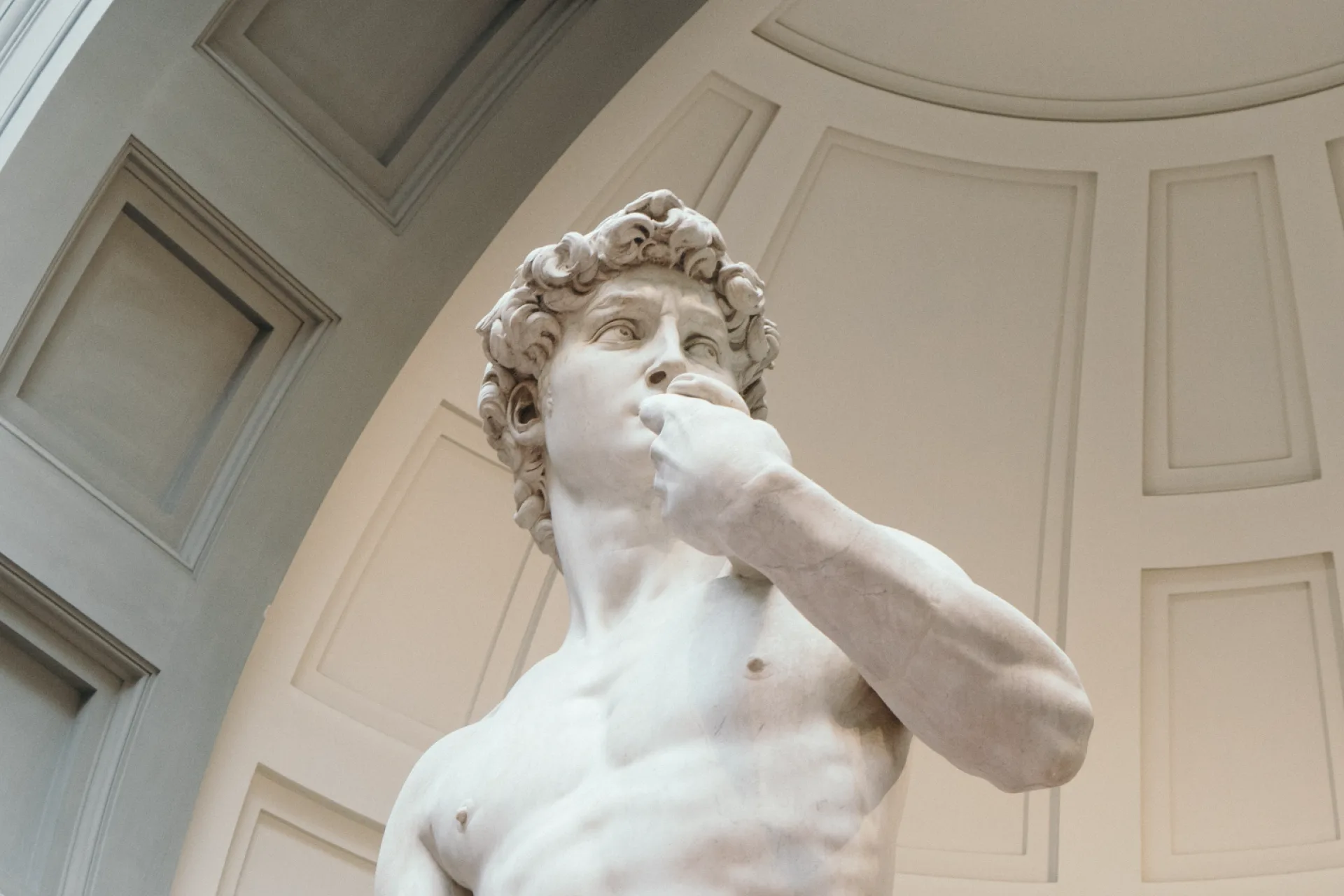
Michelangelo’s David is the most famous statue in the world, and that is precisely the problem. Most visitors arrive with the image already in their heads, take the photo and leave, without noticing that the real thing contradicts the postcard. Seen up close, it is full of details the photos flatten out.
A Block of Marble Nobody Wanted
The story starts with failure. In 1464 the cathedral workshop in Florence commissioned a giant figure for one of the buttresses high up on the Duomo, and Agostino di Duccio began roughing out a tall, narrow block of Carrara marble. He gave up. Twelve years later Antonio Rossellino tried and gave up too. For decades the damaged block lay in the workshop yard, and Florentines simply called it “the Giant”.
In 1501 the workshop offered it to a 26-year-old Michelangelo. He worked on it for almost three years inside a wooden enclosure in that same yard, and finished in 1504. The result is 5.17 metres of marble. The block was already shallow and partly carved, which is why David is unusually slim when seen from the side. Michelangelo did not choose those proportions. He solved them.
Why David’s Hands and Head Look Too Big
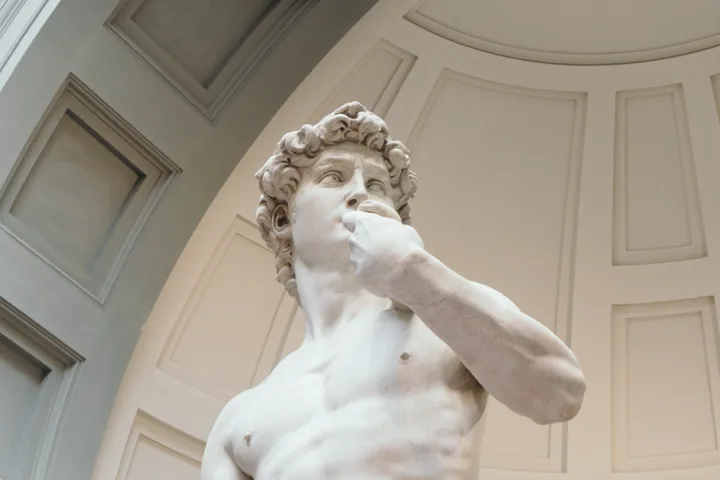
The right hand hanging by his thigh and the head are both oversized for the body. The usual explanation is that the statue was conceived to stand high on the cathedral, seen from far below, where a sculptor enlarges the parts the eye needs to read. Once it was finished, a committee that included Leonardo da Vinci and Botticelli decided it deserved better than a buttress, and David was placed at ground level in Piazza della Signoria, as a symbol of the small republic standing up to more powerful enemies.
Stand on the statue’s right side and look up at the right hand: you will see the veins standing out on its back. The sling hangs over his left shoulder and the stone is hidden in his right palm. Get close enough and you may notice that the pupils are carved in the shape of a heart. This is usually read not as David after defeating Goliath, as earlier sculptors showed him, but as David a moment before the fight, deciding.
The Corridor That Prepares You
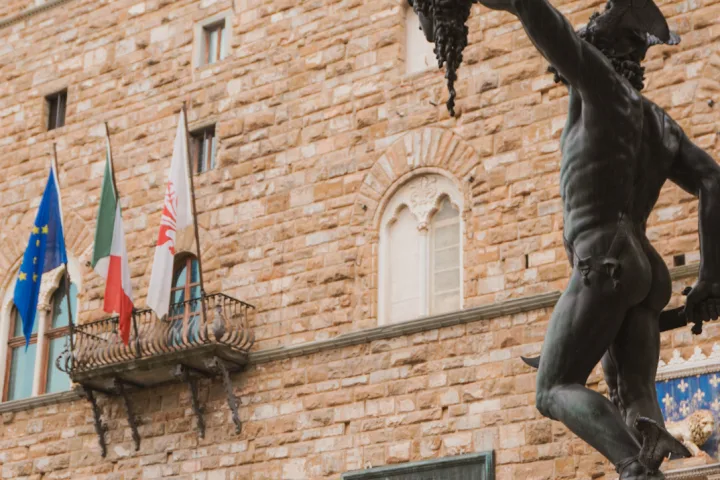
David stood outdoors until 1873, when he was moved to the Galleria dell’Accademia for protection. A copy has occupied his original spot in the square since 1910: the David in Piazza della Signoria is a replica, and the original is only at the Accademia. Inside the museum, the statue stands at the end of a long hall, in a tribune with a skylight completed in 1882 specifically for it.
Do not walk that hall too quickly. It is lined with Michelangelo’s Prisoners, four figures carved years later for the tomb of Pope Julius II and left unfinished, half-emerged from rough blocks of stone. They show exactly how he worked, removing marble from the front towards the back, as if releasing a body trapped inside. Walk slowly along them, and David at the far end looks like what that struggle produces when it is finished.
How to See the David Without the Crowds
Entry is by timed ticket and slots sell out well in advance, especially from spring to autumn, so book on the official site. The gallery opens at 8:15 and is closed on Mondays; hours change on some holidays, so check before you go. An hour to an hour and a half is enough for David, the Prisoners and the collection of musical instruments. The first hour of the morning and the last hour before closing are the calmest, when you can walk all the way around the statue without a crowd in every photo.
Walk a full circle before you take a picture. Look from behind, where the weight shifts onto the right leg, and from the left side, where the face finally shows its expression. Then step back towards the Prisoners and look again from a distance.
A guide who knows where to stand makes the difference. Our private tour of the Accademia starts early to beat the queues, and if you still have energy afterwards, there are five more museums worth your time in our guide to Florence beyond the Uffizi.