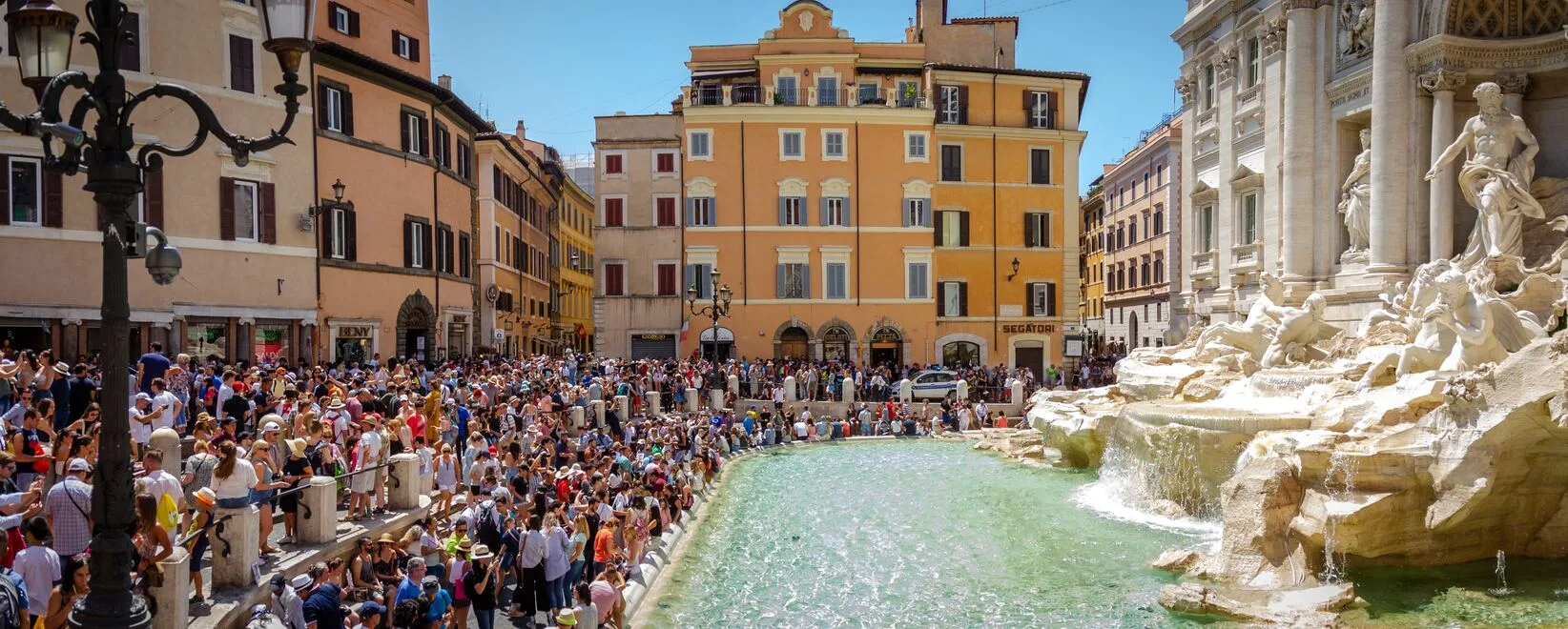
The Trevi Fountain is the most crowded twenty metres in Rome, and almost nobody standing in front of it knows what they are looking at. Most visitors arrive, throw a coin, take the photo and leave within ten minutes. The fountain rewards a longer look: it is a piece of Baroque theatre built on top of an aqueduct that has been running for two thousand years.
Water That Has Been Flowing Since 19 BC
The fountain marks the end point of the Aqua Virgo, an aqueduct completed in 19 BC under Marcus Agrippa to feed the baths near the Pantheon. It is the only ancient aqueduct in Rome that has worked almost without interruption since antiquity. The name comes from a legend in which a young girl, a virgo, showed thirsty Roman soldiers where the spring was. She appears in a relief on the upper right of the facade, pointing at the water.
For centuries the outlet was a modest basin. In 1732 Pope Clement XII launched a competition to build something grander, and a relatively unknown architect named Nicola Salvi won it. He died in 1751 with the work half done. Giuseppe Pannini finished it, and the fountain was inaugurated in 1762.
What You Are Actually Looking At
The whole composition is a stage set. The back wall is the side of Palazzo Poli, turned into a triumphal arch. In the central niche stands Oceanus, the god of all water, riding a shell-shaped chariot pulled by two sea horses: one calm, one wild, representing the two moods of the sea. The tritons wrestling them are the only figures actually doing any work.
On either side of Oceanus are Abundance, holding a horn of plenty, and Health, holding a cup from which a snake drinks. Above them the two reliefs tell the aqueduct’s story: Agrippa approving the plans on the left, the girl showing the spring on the right. The rock the whole thing sits on is carved travertine, the same stone as the Colosseum, sculpted to look as if the palace is dissolving into a cliff.
The Coin: How to Throw It and Where the Money Goes
The ritual is precise. Stand with your back to the fountain, hold the coin in your right hand and throw it over your left shoulder. One coin guarantees you will return to Rome. The tradition of a second coin for a new romance and a third for a wedding is a later invention, popularised by the 1954 film Three Coins in the Fountain.
The coins are real money. Around a million and a half euros are fished out every year, and since 2001 the entire amount has gone to Caritas, the Catholic charity, to fund soup kitchens and social projects in Rome. Taking coins out of the basin is theft and the police do prosecute it.
Getting into the water is another matter entirely. Anita Ekberg waded in for Fellini’s La Dolce Vita in 1960, and every summer someone tries to repeat it. The fine runs to several hundred euros and the basin is watched constantly.
How to See It Without the Crowd
The fountain is lit all night and never closes, which is the whole secret. Between 7 and 8 in the morning you will share it with a few joggers and a street sweeper. After midnight it is quieter still, and the floodlit travertine is at its best. Between 10 am and 10 pm the square is packed to the edges, and since 2024 the city has been experimenting with managed entry to the lower steps, so expect a queue in the middle of the day.
It sits in a tight knot of streets ten minutes on foot from the Spanish Steps and five from the Pantheon, so it fits naturally into a morning walk. For gelato afterwards, walk at least three streets away from the square: the shops facing the fountain are the ones our guide to real gelato in Rome tells you to avoid.