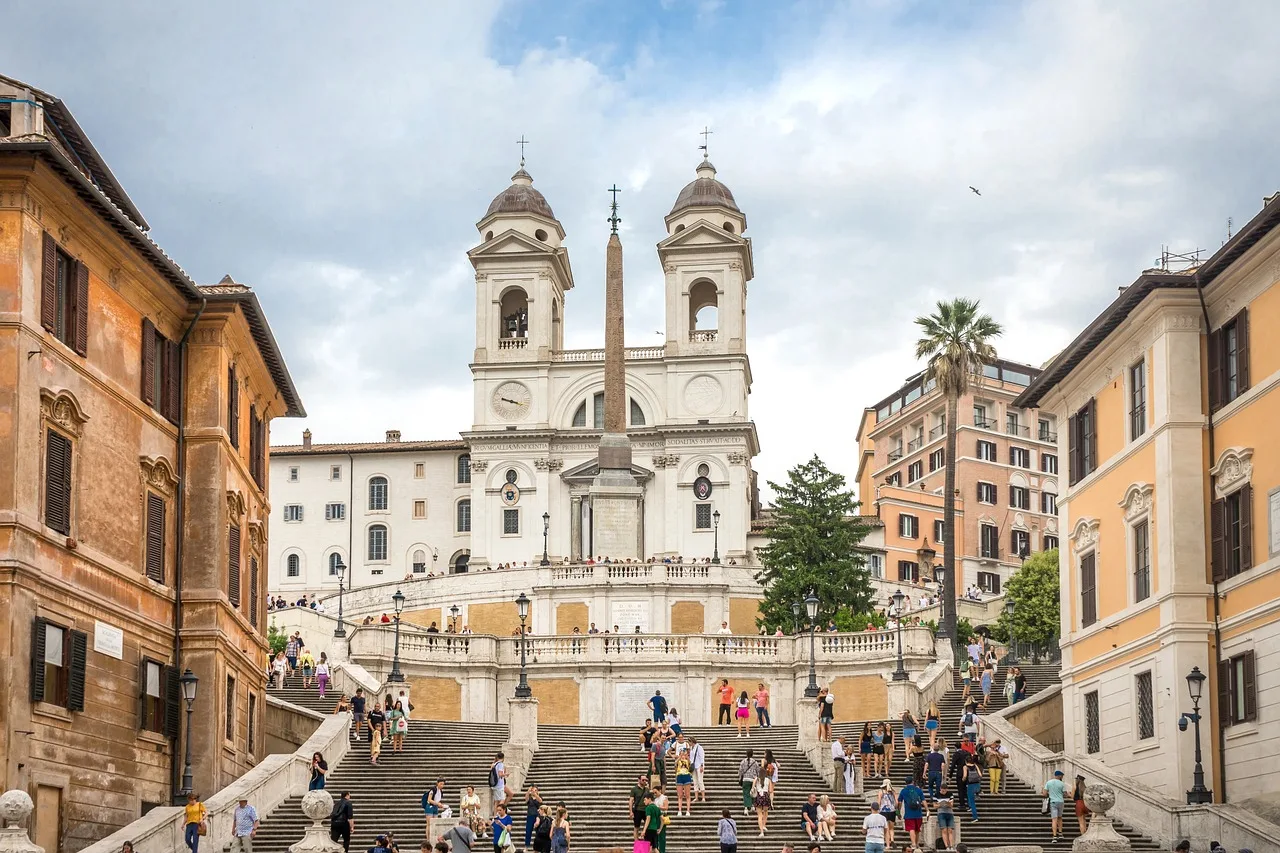
The Spanish Steps are one of the most photographed staircases in the world. They are also the result of a 300-year diplomatic argument between France, Spain and England, fought through ambassadors and church architects in 17th-century Rome. The staircase you climb today was almost never built, and the politics behind it are more entertaining than the climb itself.
A French Church, a Spanish Embassy and an English Street
To understand the Spanish Steps, you need to know which country owned what. At the top of the staircase sits the Church of Trinita dei Monti, a French church built in the 16th century by King Louis XII. At the bottom of the steps sits the Piazza di Spagna, named after the Spanish Embassy to the Holy See, which still occupies the same building today.
And the street that runs from the steps to Piazza del Popolo? Via dei Condotti. In the 18th century, it was nicknamed “the English Street” because of the number of English Grand Tour travelers staying in its hotels and writing letters home from its cafes.
Three nations, one square. The fight over who controlled the slope between the French church and the Spanish embassy lasted a century.
Why the Steps Almost Were Not Built
The French wanted a monumental staircase that would honor the king of France and lead grandly up to “their” church. The Spanish refused to accept any design that suggested French dominance over a Roman piazza named after Spain. The Vatican, who technically held jurisdiction over the area, played the two ambassadors against each other for decades to keep both happy and neither powerful.
The project was proposed in 1660, abandoned, proposed again in 1670, abandoned, and only revived in 1717 when a French diplomat, Etienne Gueffier, left money in his will specifically to build the staircase. Even then, the design was rejected by the Pope twice before a Roman architect, Francesco De Sanctis, presented a plan in 1723 that both France and Spain could accept.
The Construction (1723 to 1726)
The final design is a clever piece of political architecture. The staircase divides into three flights, each one symbolic. Some historians read the three flights as a tribute to the Holy Trinity (the name of the church above), others as a balance between the three powers involved. The number of steps depends on how you count: most sources say 135, but the exact number varies depending on which landings you include.
Construction took three years. The fountain at the bottom, the Fontana della Barcaccia, was already there: it was carved by Pietro Bernini and his son Gian Lorenzo around 1627, in the shape of a sinking boat, supposedly inspired by a flood of the Tiber that left a real fishing boat stranded in the piazza.
Hidden Details to Spot
The fleur-de-lys carved into the railings: a reference to the French crown that financed the staircase. The eagles on the lower flights: a tribute to Pope Innocent XIII, who finally approved the project. The “Casa di Goethe” plaque on a building to the right: Goethe lived there during his Italian journey in 1786 and 1787. The Keats-Shelley House at the foot of the stairs: a small museum dedicated to the English Romantic poets who lived and died in Rome.
When to Visit (And When to Avoid)
Early morning, just after sunrise, is the only time the steps are quiet. By 10 am they fill with tour groups, by midday they are packed. Sitting or eating on the steps is now forbidden and fines are real (around 250 euros). Take your photos and move on.
The view from the top, looking down past the Barcaccia fountain and along Via dei Condotti to Piazza del Popolo, is the one to take. From there, you understand why three nations argued for a century to control this slope.